
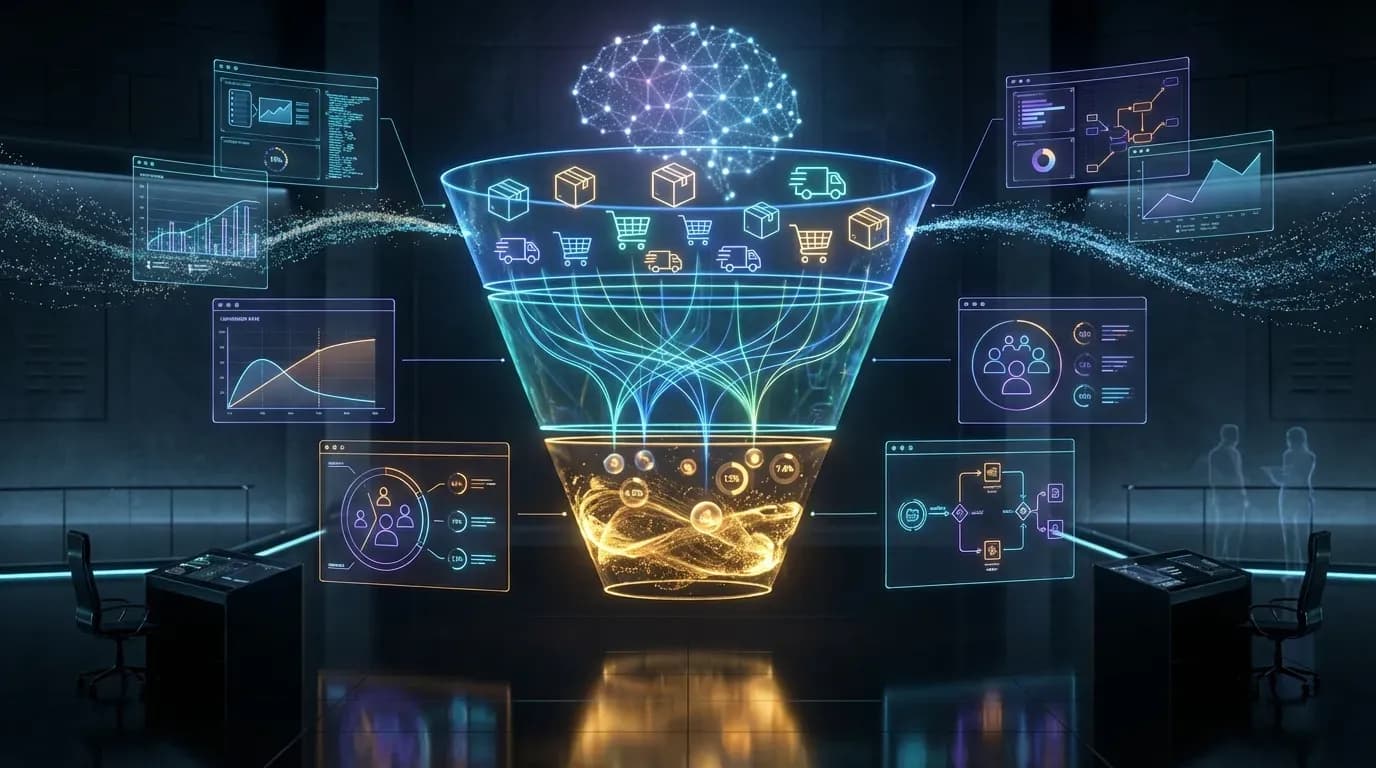
Understanding E-Commerce Funnel Structures in 2026
E-commerce has evolved from simple online catalogs into complex, automated customer journeys. At the core of every successful online store lies a well-structured funnel that intentionally guides users from discovery to purchase and beyond. An effective e-commerce funnel structure is not just a marketing diagram; it is a measurable, automated system that aligns ads, content, UX, and technology to maximize revenue and customer lifetime value.
For businesses, startups, e-commerce brands, and digital agencies, mastering funnel structures is no longer optional. Competition, ad costs, and customer expectations demand a smarter way of converting traffic into sales. In this article, we will break down the key stages of an e-commerce funnel, explain how to architect each layer, and show where automation and intelligent tooling can dramatically improve performance.
The Core Stages of an E-Commerce Funnel
While every brand is unique, most high-performing e-commerce funnels share a similar backbone. A clear structure allows you to track performance and identify bottlenecks at each stage.
1. Awareness: Attracting the Right Traffic
The awareness stage is where potential customers first encounter your brand. The goal here is not immediate sales but qualified attention. Your funnel structure should define which channels attract which types of traffic and what message they see first.
Common awareness channels include:
- Paid social ads (Meta, TikTok, LinkedIn for B2B e-commerce)
- Search ads and Shopping ads (Google, Bing)
- SEO-driven content (blogs, landing pages, comparison pages)
- Influencer and affiliate marketing
- Email list building from lead magnets or pre-launch campaigns
At this stage, your funnel structure should define clear entry points: which campaigns drive traffic to which landing pages, what tracking parameters are added, and which audiences are tagged for later remarketing.
2. Consideration: Guiding Product Discovery
Once visitors land on your site, the next stage is consideration. They are exploring products, comparing options, and evaluating trust signals. A strong funnel structure translates this into specific page flows and UX patterns.
Key elements of the consideration phase include:
- Optimized category and collection pages with clear filters
- High-converting product detail pages (PDPs) with strong visuals, social proof, and clear benefits
- Content that educates (size guides, comparison charts, FAQs, how-to guides)
- Exit-intent or timed pop-ups for discounts or email capture
- Personalized recommendations based on browsing behavior
Your funnel structure should outline what happens when a user views X number of products, scrolls Y percent of a page, or returns within Z days. These rules are the foundation of automated sequences, dynamic offers, and remarketing audiences.
3. Conversion: Turning Intent into Transactions
The conversion stage covers the transition from cart to completed order. This is where friction kills revenue, and every detail of your funnel matters. The more intentional your structure, the more predictable your conversion rates become.
Critical components at this stage are:
- Streamlined cart experience (clear summaries, editable items, visible discounts)
- Simple, mobile-first checkout with minimal steps and guest checkout options
- Multiple payment methods (cards, wallets, BNPL options where relevant)
- Trust signals like security badges, guarantees, and transparent shipping info
- Automated cart and checkout abandonment flows via email, SMS, or push notifications
An advanced e-commerce funnel structure defines triggers such as: "user adds to cart but does not purchase within 1 hour," or "user reaches payment step but abandons," and automatically sends tailored recovery messages, reminders, or time-limited offers.
4. Retention: Turning One-Time Buyers into Loyal Customers
A sale is not the end of the funnel; it is the beginning of a new cycle. High-performing e-commerce brands build funnel structures that extend far beyond the first purchase. Retention funnels focus on building loyalty, increasing average order value, and raising customer lifetime value.
Retention-focused tactics include:
- Post-purchase email sequences (thank you, education, cross-sell, usage tips)
- Replenishment reminders based on product lifecycle
- Loyalty programs, member-only offers, and early access campaigns
- Automated review and UGC requests to strengthen social proof
- Win-back campaigns targeting inactive customers after a defined period
Your retention funnel structure should map out exactly when and how you re-engage customers depending on their behavior, purchase frequency, and total spend.
Designing the Architecture of Your E-Commerce Funnel
Beyond the conceptual stages, an e-commerce funnel needs a clear technical and operational architecture. This is where a software and automation-first approach creates sustainable competitive advantage.
Map the Full Customer Journey First
Start by visually mapping the journey from first impression to repeat purchase. Document:
- Entry channels and campaigns
- Key landing pages and flows (home, category, PDP, cart, checkout)
- Touchpoints where users typically drop off
- Data captured at each step (email, UTM parameters, behavior events)
- Automations triggered (emails, ads, messages, internal notifications)
This blueprint becomes the reference for all optimization and automation work. For digital agencies, it also creates a transparent framework for client communication and reporting.
Align Technology Stack with Funnel Stages
Modern e-commerce funnels rely on a stack of integrated tools. Instead of selecting tools in isolation, choose them based on the role they play in your funnel stages.
Typical stack components include:
- Commerce platform: Shopify, WooCommerce, BigCommerce, or a headless solution
- Analytics & tracking: Google Analytics 4, server-side tracking, pixel management
- Marketing automation: Klaviyo, HubSpot, ActiveCampaign, or similar
- Ad platforms: Meta, Google, TikTok, programmatic networks
- On-site personalization: recommendation engines, A/B testing tools
- Automation layer: workflow and integration tools that orchestrate data and actions across systems
The funnel structure should explicitly document which tool handles which step, how data flows between them, and what events are required to trigger automations.
Define Events, Triggers and Segments
A high-performing e-commerce funnel runs on well-defined data events. Instead of broad, generic campaigns, your structure should be driven by precise triggers and segmented audiences.
Core events to track include:
- Viewed product
- Added to cart
- Initiated checkout
- Completed purchase
- Viewed specific category or collection
- Used discount code
- Clicked on specific campaign or UTM source
Using these events, you can define segments such as "high-intent browsers," "cart abandoners," "loyal customers," or "first-time buyers with high average order value." Each segment is then connected to specific messages and offers within the funnel structure.
Automation Strategies Inside the E-Commerce Funnel
Automation is where e-commerce funnel structures become scalable and efficient. Instead of manually managing dozens of campaigns, you can create rules-based workflows that respond in real time to user behavior.
Automated Sequences for Each Funnel Stage
Consider building dedicated automation sequences aligned to funnel moments:
- New visitor nurture flows: educational content, brand story, and soft offers for users who subscribe but have not yet purchased.
- Browse abandonment flows: product-focused reminders for users who viewed items multiple times without adding to cart.
- Cart abandonment flows: multi-step sequences that combine urgency, social proof, and sometimes an incentive.
- Post-purchase flows: onboarding, usage tips, cross-sell recommendations, and requests for reviews.
- Reactivation flows: win-back campaigns for customers who have been inactive for a defined period.
With a well-designed infrastructure, these sequences work together as part of one unified funnel rather than isolated campaigns.
Dynamic Content and Personalization
Modern e-commerce funnel structures leverage dynamic content to adapt messaging to each user. Personalization can include:
- Showing recently viewed products on the homepage or in emails
- Displaying category-specific banners based on browsing history
- Adjusting onsite offers according to traffic source or campaign
- Recommending complementary products after purchase
These tactics increase relevance and conversion without requiring constant manual adjustments. The key is a clear funnel plan that defines where personalization adds the most impact.
Measuring and Optimizing Your E-Commerce Funnel
A funnel structure is not static. It must be monitored and refined based on performance data. By treating your funnel as an evolving system, you can continuously increase revenue without constantly increasing ad spend.
Key Metrics by Funnel Stage
Typical metrics to monitor include:
- Awareness: click-through rate (CTR), cost per click (CPC), new user sessions
- Consideration: product views per session, time on site, add-to-cart rate
- Conversion: checkout initiation rate, cart-to-checkout rate, checkout completion rate, overall conversion rate
- Retention: repeat purchase rate, time between orders, customer lifetime value (CLV)
By aligning metrics with funnel stages, you can quickly see where leakage is happening and prioritize optimization efforts.
Iterative Testing and Continuous Improvement
Optimization should be built into your funnel structure as an ongoing process. Incorporate A/B tests and controlled experiments into:
- Landing page headlines and hero sections
- Product page layouts and call-to-action buttons
- Cart and checkout steps
- Email subject lines, send times, and sequences
- On-site offers and pop-up triggers
Document each test within your funnel architecture, including the hypothesis, variant details, and outcome. Over time, this creates a knowledge base that informs better decisions and more effective campaigns.
Putting It All Together: Building a Scalable Funnel Framework
Designing effective e-commerce funnel structures is about more than drawing a simple diagram; it is about combining strategy, technology, data, and automation into one coherent system. For businesses, startups, e-commerce brands, and digital agencies, a scalable funnel framework should:
- Map the end-to-end customer journey across all digital touchpoints
- Define clear stages, events, and triggers for every interaction
- Integrate your tech stack so data flows seamlessly between tools
- Automate key communications based on real behavior, not guesswork
- Continuously measure and optimize each stage for maximum impact
When executed correctly, this approach not only improves conversion rates and revenue but also reduces operational friction and manual workload, enabling teams to focus on strategy rather than repetitive tasks. For organizations that want to accelerate this journey, partnering with a software and automation-focused agency can significantly shorten the learning curve and implementation time. At lakverse.com, you will find services and products specifically designed to provide solutions for building, automating, and optimizing advanced e-commerce funnel structures in a reliable and scalable way.

