
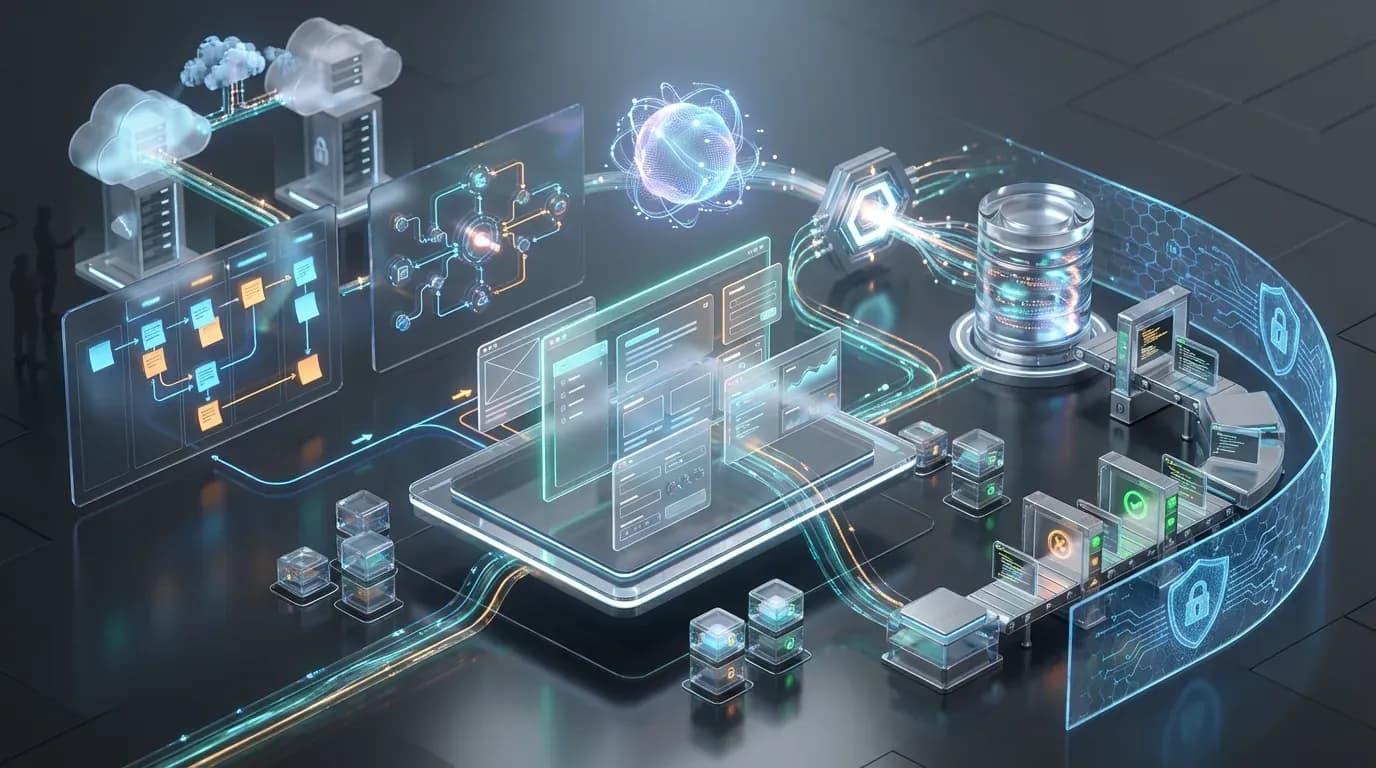
What Is a Corporate Web Application?
Corporate web applications are browser-based software systems designed to support critical business operations such as customer portals, partner dashboards, internal workflows, and e‑commerce platforms. Unlike simple marketing websites, they are dynamic, data-driven, and deeply integrated with other systems such as CRMs, ERPs, and payment gateways.
For startups, digital agencies, e‑commerce brands, and established enterprises, a well-architected web application becomes a core asset: it automates processes, improves customer experience, and generates measurable business value. Understanding how these applications are developed helps stakeholders make better decisions about scope, budget, timelines, and technology choices.
1. Discovery and Requirements: Turning Business Goals into a Roadmap
Every successful corporate web application starts with clear alignment between business stakeholders and the technical team. The discovery phase transforms high-level ideas into concrete, testable requirements.
1.1 Business Analysis and Stakeholder Interviews
The process usually begins with workshops and interviews involving management, operations, sales, marketing, customer support, and technical teams. The goal is to answer questions such as:
- What business problem are we solving or which opportunity are we pursuing?
- Who are the primary users (customers, partners, internal teams)?
- Which manual processes should be automated or optimized?
- Which KPIs will define project success (conversion rate, processing time, error reduction, revenue)?
These insights are translated into business requirements and prioritized features, often documented as user stories such as “As a sales manager, I want to see real-time order status so that I can proactively inform customers.”
1.2 Technical and Integration Requirements
At the same time, architects and senior developers analyze the technical ecosystem:
- Existing systems: CRM, ERP, accounting software, legacy databases
- Integration needs: APIs, webhooks, single sign-on (SSO), payment providers
- Security and compliance: data protection, audit trails, access control
- Non-functional requirements: performance, scalability, availability, SLAs
The output of discovery is typically a requirements specification or product backlog that guides the rest of the development lifecycle.
2. UX and UI Design: Crafting an Intuitive Experience
Corporate web applications succeed only if people actually use them. That makes user experience (UX) and interface design (UI) a critical step, not a cosmetic add‑on.
2.1 User Journeys and Information Architecture
UX designers map user journeys to understand how different personas navigate the application to achieve their goals. Typical steps include:
- Defining personas (e.g., store owner, operations manager, support agent)
- Mapping end‑to‑end flows (onboarding, placing an order, approving a request)
- Structuring content with information architecture and navigation schemes
The outcome is a logical structure that minimizes friction and cognitive load, ensuring that complex business functions remain approachable for daily users.
2.2 Wireframes, Prototypes, and Visual Design
Designers then create low-fidelity wireframes to validate layout and flows, followed by high‑fidelity prototypes reflecting the final look and feel. For corporate applications, design guidelines often consider:
- Brand consistency with logos, typography, and color palette
- Accessibility best practices (contrast, font sizes, keyboard navigation)
- Responsive layouts for desktops, tablets, and mobile devices
Interactive prototypes allow stakeholders to test the interface early, providing feedback before development resources are heavily invested.
3. Architecture and Technology Stack: Building the Foundation
Before coding, the technical team defines the application architecture and selects the technology stack. These decisions influence performance, security, maintainability, and total cost of ownership.
3.1 Choosing the Right Architecture
Common architectural patterns for corporate web applications include:
- Monolithic applications for smaller, simpler solutions with limited integrations.
- Layered (n‑tier) architectures separating presentation, business logic, and data access layers.
- Microservices architectures for large, scalable systems with independent services.
The choice depends on current needs, expected growth, and the complexity of the business domain. For many growing startups and mid‑size companies, a modular monolith or a hybrid approach is a pragmatic starting point.
3.2 Frontend, Backend, and Database Technologies
Typical technology choices for corporate web applications may include:
- Frontend: Modern JavaScript frameworks such as React, Vue, or Angular for responsive, component-based interfaces.
- Backend: Robust frameworks in languages like Node.js, .NET, Java, or Python to implement business logic and APIs.
- Databases: Relational databases (PostgreSQL, MySQL, SQL Server) and, where needed, NoSQL databases (MongoDB, Redis, Elasticsearch) for specific use cases.
Additionally, decisions must be made about API styles (REST, GraphQL), messaging systems (queues, event buses), and caching layers, all of which influence scalability and responsiveness.
4. Development Phase: Implementing Features Iteratively
With requirements and architecture in place, development teams begin implementing the application in iterative cycles, often using Agile or Scrum methodologies.
4.1 Backend Development
Backend developers implement business rules, data structures, and integrations. Their work generally includes:
- Designing and optimizing database schemas
- Developing secure APIs and services
- Implementing authentication and authorization mechanisms
- Integrating with external systems (CRM, ERP, payment providers, logistics APIs)
Clean architecture principles, domain-driven design, and layered patterns help keep the codebase testable, maintainable, and resilient to change.
4.2 Frontend Development
Frontend developers translate designs into interactive, performant user interfaces. This includes:
- Implementing reusable UI components (forms, tables, charts, dashboards)
- Managing application state and data fetching from APIs
- Ensuring responsiveness and cross‑browser compatibility
- Handling input validation and user feedback
Strong collaboration between frontend and backend teams is essential to define clear API contracts and maintain a smooth development flow.
5. Quality Assurance: Testing, Security, and Performance
Corporate web applications must be reliable and secure, as they often touch sensitive data and mission‑critical processes. Quality assurance is embedded throughout the lifecycle, not just at the end.
5.1 Automated and Manual Testing
Professional teams combine automated and manual testing approaches, including:
- Unit tests for individual functions and services
- Integration tests to validate interactions between components
- End‑to‑end tests simulating real user flows in the browser
- Regression testing to ensure new features do not break existing ones
Test coverage and continuous integration pipelines are key metrics to ensure consistent quality over time.
5.2 Security and Performance Reviews
Security is non‑negotiable in corporate environments. Typical measures include:
- Implementing robust authentication, role-based access control, and encryption
- Protecting against common vulnerabilities such as SQL injection, XSS, CSRF, and insecure direct object references
- Conducting security audits and, where needed, penetration tests
Performance is validated through load testing, profiling, and optimization of database queries, caching strategies, and asset delivery to ensure the application can handle expected traffic and peak loads.
6. Deployment, DevOps, and Maintenance
Once the application is stable and validated, it is prepared for production deployment. For modern corporate web applications, DevOps practices and cloud infrastructure are standard.
6.1 CI/CD and Cloud Infrastructure
DevOps engineers set up continuous integration and continuous delivery (CI/CD) pipelines that automatically build, test, and deploy code. This reduces manual errors and accelerates release cycles. Typical infrastructure components include:
- Cloud providers such as AWS, Azure, or Google Cloud
- Containerization with Docker and orchestration with Kubernetes for scalability
- Monitoring and logging tools to track performance, uptime, and errors
Infrastructure as Code (IaC) ensures that environments are reproducible, versioned, and easy to maintain.
6.2 Ongoing Support, Enhancements, and Governance
Corporate web applications evolve with the business. After launch, teams focus on:
- Monitoring application health and responding to incidents
- Rolling out new features based on user feedback and analytics
- Keeping dependencies and security patches up to date
- Refining architecture to support new products, markets, or integrations
Governance frameworks, documentation, and clear ownership ensure the application remains sustainable and aligned with strategic objectives.
7. Key Takeaways for Businesses Planning a Corporate Web Application
Developing a corporate web application is not just a technical exercise; it is a strategic initiative that touches people, processes, and technology across the organization. Success depends on aligning requirements with business goals, investing in UX and architecture, adopting disciplined development and QA practices, and maintaining a DevOps mindset to ensure reliability and scalability. For businesses, startups, e‑commerce firms, and digital agencies seeking a partner in this journey, lakverse.com offers services and products capable of delivering robust, secure, and scalable web application solutions fully aligned with the topics discussed in this article.

